
STRING THEORY – Tangled up in Calvine (Part 1)
Andreas Zätterqvist and Oskar Jungell’s investigation of the Calvine UFO Photograph By Andrew Robinson, Senior Lecturer in Photography, Sheffield Hallam University 31st July 2026

PART ONE - HUNTERS IN THE HIGHLANDS
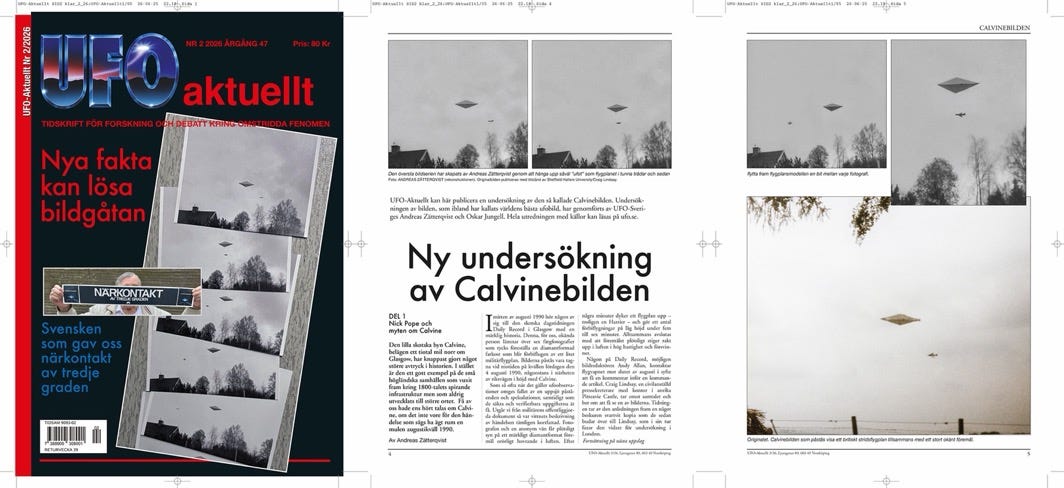
Introduction
The stories that grow up around reports of UFO sightings, especially those that are shared widely and achieve notoriety, attract equally passionate believers and sceptics, and morph and change as they are repeated and passed from person to person via word of mouth, social media and publication. As such they function as form of contemporary legend with their own associated folklore. Unknown to all but a select few until 1996, and attracting little public interest until 2022, the last four years has seen considerable discussion and debate surrounding the 1990 Calvine UFO sighting which is quickly developing it’s own complex mythology.
In a recent feature published in the latest edition of the Swedish UFO magazine UFO-Aktuellt Andreas Zätterqvist and Oskar Jungell investigate the Calvine case through a study of the ‘Lindsay Print’, the only surviving photograph of the sighting, with Jungell concluding that “we cannot draw any conclusion other than that it is a hoax” (Zätterqvist & Jungell 2026 pp. 8). Their article offers an alternative explanation to that provided by the two witnesses who in August 1990 provided a set of six colour photographs and eyewitness testimony to the Glasgow Daily Record and RAF press officer Craig Lindsay.
As a member of the Research Team formed by Dr David Clarke to investigate the Calvine sighting and having undertaken the first in-depth study of the Lindsay Print after Clarke secured its donation to Sheffield Hallam University’s Special Collections (Calvine, 2025), I decided to investigate the evidence presented in the article and reflect further on the complexities of the Calvine case.
THE LINDSAY PRINT
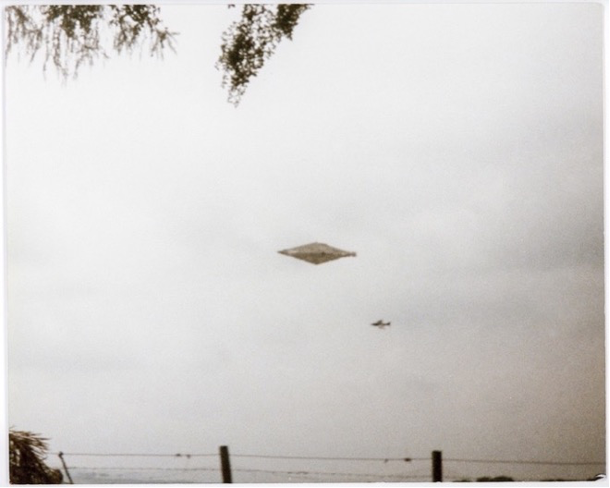
The ‘Lindsay Print’ is the only surviving photographic image of the Calvine sighting which allegedly took place on the 4th August 1990 claimed by many to be the best UFO photograph ever captured. It is a black and white copy print produced by the Glasgow Daily Record from one of six colour originals prints and sent to RAF Press Officer Craig Lindsay for comment. Lindsay kept this print amongst his papers for over 31 years before it was donated to Sheffield Hallam University and published alongside the story of its discovery by Dr David Clarke in August 2022. The only other surviving images of the Calvine sighting in existence are two photocopies made by Lindsay in order to fax the image to the MoD which he also kept, along with two poor quality photocopies made from Vu-Foils (images on transparent film) of a cropped version of the same image which were released by the MoD in 2009 (Robinson 2024). Given that the surviving print is a cropped black and white copy rather than a print from the original colour negative, we should refer to this image as the ‘Lindsay Print’ in order to distinguish it from the six original images which were seen and handled by the MoD, the Daily Record, the photographers and a number of key witnesses.
Hanging Models
Zätterqvist and Jungell reject the original witness’s explanation of the photograph and propose that image is a hoax produced by hanging models in the foreground of the scene. This hypothesis has been suggested a number of times since the Lindsay Print was first published in August 2022 and if the image is indeed a hoax, I believe this remains the most likely explanation. I considered this possibility in my original investigation published in 2022 and updated in 2024 (Robinson, 2024) however my interpretation of the focus and depth of field within the photograph led me to believe that both the UFO and aircraft were at a greater distance from the camera than the fence and trees and thus couldn’t be models suspended in the foreground. Given the limited data available I wasn’t able to prove this conclusively and the possibility exists that the hanging model theory could offer an explanation for the image.
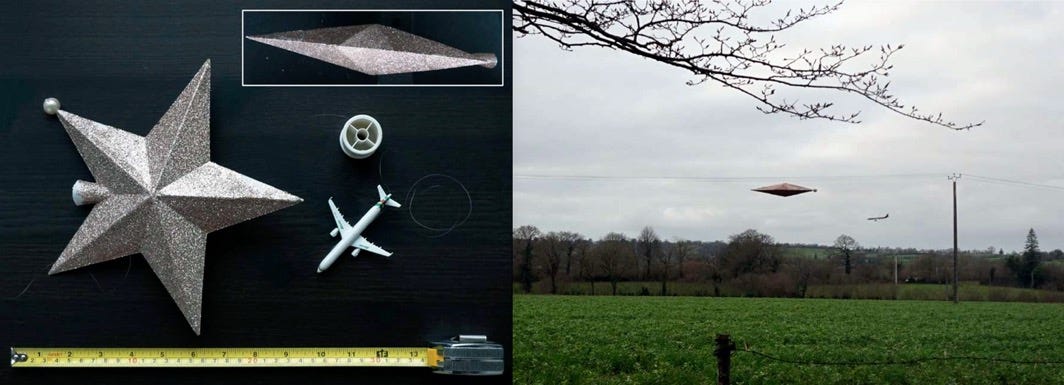
Belgium sceptic Wim van Utrecht has undertaken research into this possibility which he published online (van Utrecht, 2022 / 2023). Utrecht was successful in producing photographs similar to the Calvine image (see above) using a diamond shaped Xmas ornament and a model plane suspended from overhanging branches in the foreground of a scene. Whilst this set up provided similar results, Utrecht found it was “not as easy to accomplish as I had anticipated” because “the model was constantly rocking to and fro, making it difficult to capture it in a horizontal position” (Utrecht, 2023). The wind speed when he took the photos was 19 km/h (10 knots), similar to the wind speed reported at Calvine on the 4th August. Utrecht took 23 images to produce two with the UFO and planes suitably aligned suggesting that it would be difficult to produce a series of six successive images using this method on the moors above Calvine.
Building on Utrecht’s earlier work, Zätterqvist’s proposes that rather than hanging models from overhead branches or some other form of overhead support, the models could have been attached to horizontal wires which, if the models were of sufficient mass, would provide greater stability, offer greater control of their position, and thus produce far more believable results. He successfully demonstrates this using a UFO constructed from folded cardboard and a die-cast toy model of a Hawker Hunter producing a series of six digital images showing the aircraft passing the UFO in a believable manner.
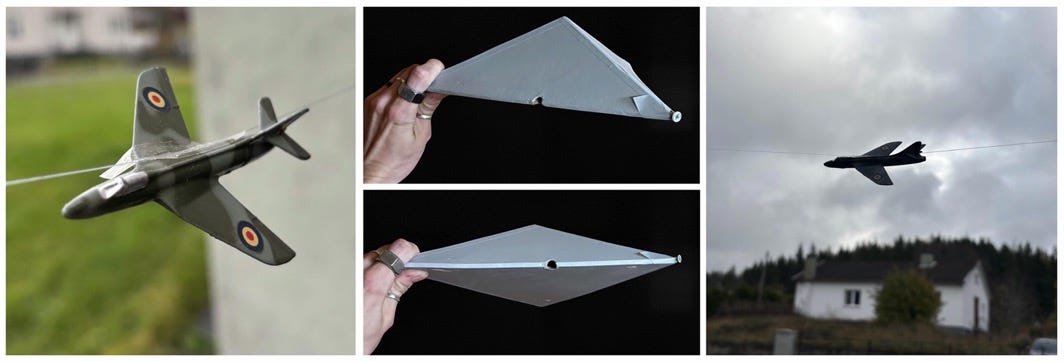
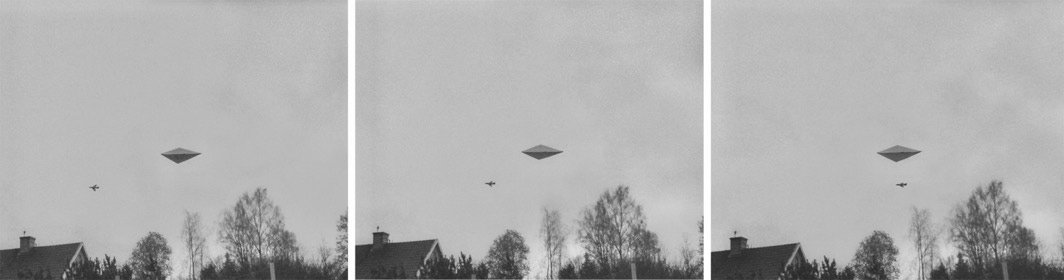
This approach requires a wire of some kind thin enough to not be recorded by the camera (Zätterqvist suggests fishing line) stretched between two points beyond the camera’s field of view such as tree trunks, telegraph poles, lampposts or buildings. The length of wire required increases with distance of the model from the camera and Zätterqvist calculates that at the distance required to reproduce a 7 cm long Dinky Hawker Hunter (Model 736) at the size of the aircraft on the Lindsay Print, the length of wire required to cover the field of view of a 50mm lens would be 2.65 metres. More readily available larger toy models, such as the 1/72 scale Airfix plastic kit (20 cm long), would need to be much further from the camera position (10.4m) in order to be reproduced at the correct size requiring horizontal wires over 7m in length.
Zätterqvist briefly considers if, rather than being a cardboard cutout, the UFO might be a kite of some kind. This idea was first proposed by sceptic Mick West on Twitter within a few hours of the Lindsay Print being publicly released in August 2022 (West, 2022).
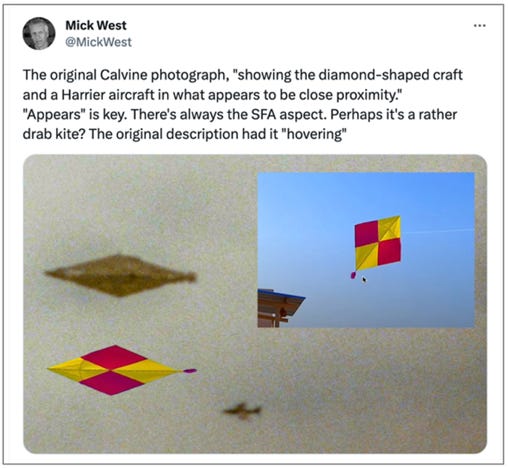
Revisiting this suggestion Zätterqvist notes how some kites on the market in 1990 might appear diamond shaped when viewed from certain angles. He also points out that on the very weekend the Calvine sighting reportedly took place, an international kite festival was being held in Glasgow noting that the “proximity of the festival makes it a plausible link” (pp. 12) and suggesting that a kite enthusiast from the festival might have travelled north to help with the creation of the Calvine hoax. Considering that the distance between Glasgow and Calvine is more than 95 miles (152 km), with a journey time of approximately 1 hour and 53 minutes this would seem a somewhat fanciful suggestion. Would a kite festival occurring in Birmingham suggest a link with a UFO sighting in Cambridge 159 km away? Or one in Gothenburg with a sighting in Jönköping 147 km away? It would seem unlikely! Although it isn’t beyond the realm of possibility that the diamond shape object captured in the Calvine photograph could be a kite, blimp or some form of inflatable or radio-controlled model, neither West nor Zätterqvist present us with any evidence that this is actually the case.
Zätterqvist’s reconstruction is successful and clearly demonstrates the technical feasibility of his horizontal fishing line hypothesis. The results, whilst not directly recreating the Calvine Photograph, show how aircraft and UFO positions can be controlled with accuracy allowing an effective means of producing a series of believable photographs similar to those at the heart of the case. The reconstruction doesn’t prove that the plane in the Calvine photograph is a toy model, or that the image was produced in this manner however it does demonstrate an effective means of staging the image available to a photographer with a 35mm film camera on the moors above Calvine in the Summer of 1990.
Hunters and Harriers
The aircraft visible in the six original Calvine photographs was identified by the MoD as a Harrier (The National Archives, 2009a pp. 157). Zätterqvist and Jungell suggest that “it is virtually out of the question” that a Harrier would have been used to intercept an unidentified flying object (2026. pp.7). Whilst many commentators have noted the unsuitability of a Harrier for such a task, given we know nothing about the situation nor the craft other than what we can see in the photograph and what was reported by the witnesses, we cannot second guess what might be taking place in the photograph, what the mission might be, or why a Harrier might be present.
The UFOaktuellt article also rejects the MoD’s identification because “upon a visual comparison, the silhouette of a Harrier fits poorly” (2026, pp. 7). The article contains a summary of Zätterqvist’s visual investigation of the aircraft in the Lindsay Print, with full details and image comparisons provided in a detailed and informative report produced in December 2025 and updated in February 2026 (Zätterqvist, 2026a). In Appendix B of this report Zätterqvist compares an enlarged section of the Lindsay Print showing the aircraft, with silhouettes of other planes. He demonstrates that the Calvine aircraft is a poor match for either a tornado or a phantom jet, two other types of aircraft stationed at nearby RAF Leuchars at the time that would have been more suitable for the task. Comparing blurred silhouettes of both a Harrier and a Hunter with the Calvine plane he concludes the Hunter is a much a more convincing match for the aircraft in the Calvine image.
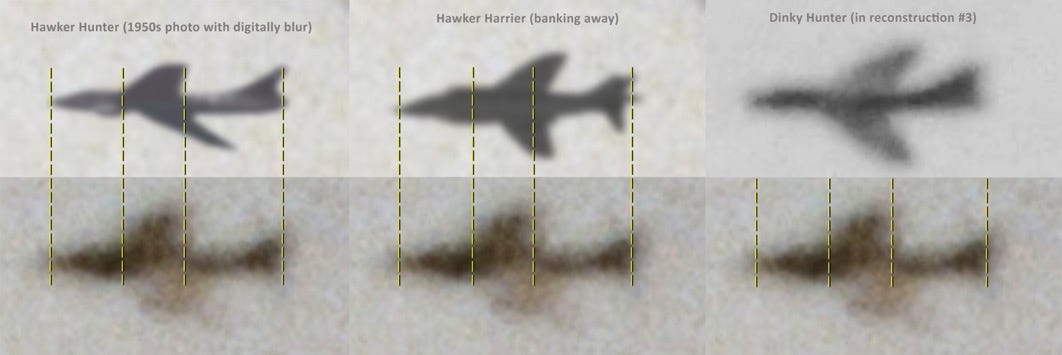
The image above shows a comparison of silhoettes of a Hawker Hunter, a Harrier and a Dinky Hunter model (top row, l - r) with the Calvine aircraft as seen on the Lindsay Print (bottom row) from Zätterqvist’s detailed report (2026). All three planes provide a fairly close match for the Calvine aircraft. The Hunter on the left is perhaps the best match however here the nose appears a little too thin, the lower wing a little too swept back and the tail a little to tall. The Harrier in the centre is also quite a good match however here the nose appears a little too fat, the upper wing a little too swept back and the tail too low, while the nose of the Dinky model on the right is too long and thin, and the upper wing too swept back.
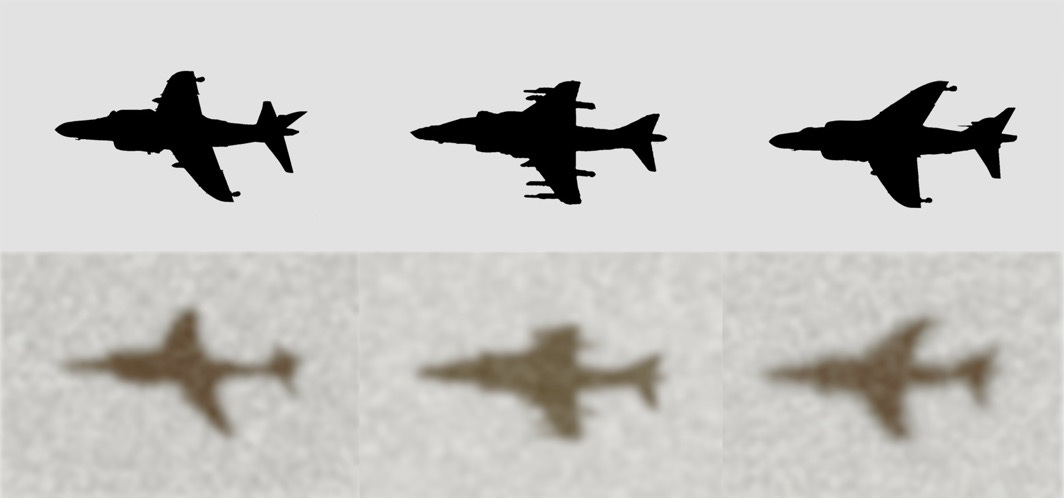
When making these comparisons we should also note that very slight alterations to the position of the plane can dramatically alter its appearance in silhouette. The images below show silhouettes of three banking harriers in slightly different positions taken from photographs of real planes alongside versions to which grain and blur similar to that present in the Lindsay Print has been applied. The same type of plane can be seen to produce dramatically different silhouettes depending on its rotation and angle relative to the camera position, especially once blur and grain are added. Note how the sweep of the wings, the thickness of the nose and appearance of the tail change considerably from image to image. This makes it difficult to make a confident identification from a single, blurred, low-quality, grainy image such as the Lindsay Print.
In 2023 ‘ThomasH’ posted a detailed 3D recreation of the Calvine photograph in Blender 3D on YouTube. In the video he demonstrates that the Calvine Photograph could indeed be produced as described by the eyewitness to the Daily Record and Craig Lindsay (ThomasH, 2023). In the video he used a detailed 3D rendering of a Harrier jet and explains:
“I found a model of a Harrier jet because that’s what was said it could have been and the shape fits really good in the final photo, so it’s not wrong…. The jet is tilted at 75° [towards the camera], but I’m not sure this is right. It could have tilted it the other way. I just couldn’t make it look right that way in my experiment.”
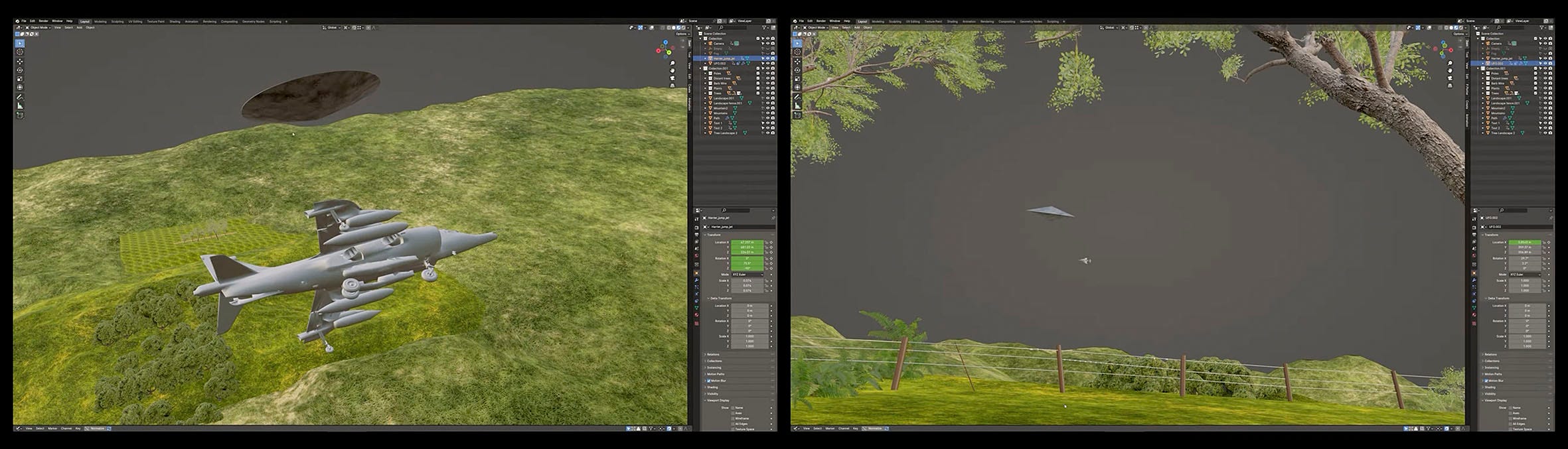
Whilst this doesn’t prove what the plane in the photograph actually is, it does demonstrate that a Harrier banking towards the camera could produce a silhouette that is a close match for the plane in the print.
Having identified the aircraft as a Hunter, Zätterqvist, & Jungell suggest that this identification “casts a dark shadow over the credibility of the image” due to the fact that at the time the photograph was taken the Hunter was an “outdated aircraft that had long since been withdrawn from frontline service” and would not be “used for escort or hunting missions” (2026. pp. 7). Although the Hunter was withdrawn from tactical weapons units in 1980 the T7A and T8B dual seat versions continued in service for a further 14 years as a surrogate trainer for the Blackburn Buccaneer within the 237 Operational Conversion Unit (OCU) alongside Nos 12 and 208 squadrons (Shaw, 2022). Between November 1980 and October 1984, the Buccaneers and Hunters were relocated from RAF Honington in Suffolk to RAF Lossiemouth in Morayshire, Scotland where they continued in service until finally retired in March 1994 (Hawker Hunter. 2022). The Hunters were fitted with Buccaneer instrumentation and used as a conversion trainer for experienced pilots moving to the Buccaneer, as well as undertaking a range of other tasks including instrument rating tests, continuation training, annual flying checks and occasionally fighter affiliation or “bouncing” (practising attack manoeuvrers on other planes) without impacting the lifespan of the aging Buccaneers (Simpson, 2012). A former pilot explains how the Hunter was also used for “hack” flying proving “very useful for doing lots of little tasks and fast taxi services a typical one being to fly a piper and his bagpipes from Lossiemouth to Yeovilton for the wardroom’s Burns Night celebration” (Eeles, 2018).
Dr David Clarke has checked the operations record books (ORBs), held by the National Archives which reveal that in 1990 ‘237 OCU were detached to Akrotiri for most of August’ (email, 30 July 2026). RAF Akrotiri is a military airbase on the Mediterranean island of Cyprus frequently used by 237 OCU for routine low-level tactical training and detachment exercises. Unfortunately, the ORB description is brief and lacking detail so we don’t know if the Hunter trainers accompanied the Squadron to Akrotiri however it is quite possible that Hunter T7As and/or T8Bs could have been flying in the skies above Calvine in the summer of 1990 while on training missions, taxing bagpipes or undertaking other ad hoc duties. Thus, even if Zätterqvist is correct in his suggestion that the aircraft may be a Hawker Hunter, this doesn’t necessarily prove that the photograph is a fake.
A Confident Identification
When trying to identify the aircraft visible in the Lindsay Print, we should always remember that the MoD made their identification not from a digital scan of a 30-year-old slightly blurred copy black and white print but, on an analysis, undertaken by two specialist MoD/RAF imaging departments of the six original full colour negatives showing the plane in a number of different positions. From these negatives the MoD were able to make duplicate prints and poster sized enlargements. Based on their analysis the MoD state they are “confident” that the plane in the photograph is a Harrier and reveal that there were no reports of Harriers flying in the area at the time the witnesses claim the photo was taken (The National Archives, 2009a pp. 157).
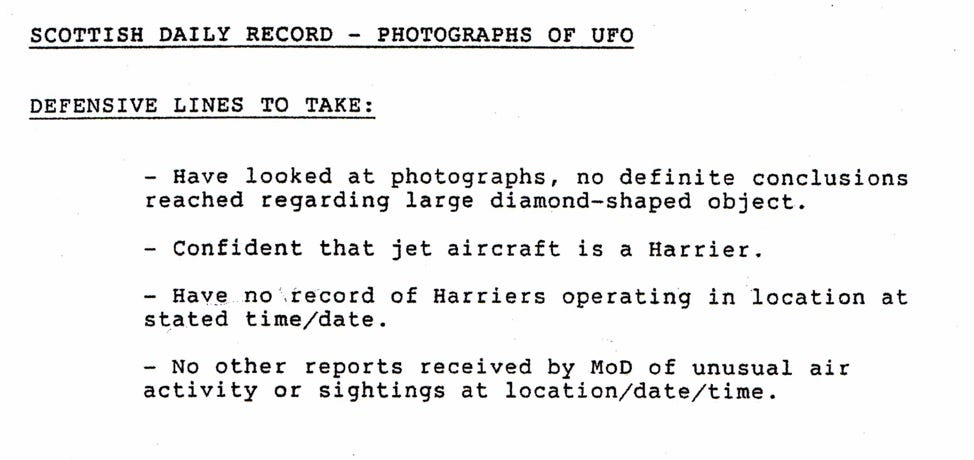
Given that these statements were made in a loose minute prepared so the Defence Ministry and MoD press office could answer questions from the press and in Parliament, it is extremely unlikely that they would make statements or claims that could not be substantiated and pass scrutiny. In my opinion, this is the MoD themselves suggesting that at this point they believe the story doesn’t add up - they are confident the plane is a Harrier, but none were flying where the witnesses claim to have captured the image.
If we believe the MoD statement this leaves two possible conclusions: the witnesses were either lying or mistaken about the date and/or location; OR the date and time were correct, but plane was not an RAF Harrier on normal duties. BAE systems had been in possession of at least one Harrier since 1975 which was used for flight and avionics testing and as a target and chase plane before it was retired in March 1994 (Russell, 2019). The US Navy (via the US Marine Corps) had their own Harriers and its long been speculated that they may have had one stationed at nearby RAF Machrihanish, although this has never been proven. It would seem unlikely that genuine witnesses would have been mistaken about the date and time of their sighting and if they were intentionally misleading the Daily Record and RAF about where and when the photo was taken this would suggest a hoax (unless there was some other reason for providing a false date and/or location). It’s worth noting here that almost all RAF personnel we have discussed the case with, including Craig Lindsay, immediately question the sighting simply because the witnesses claimed to have photographed the plane on a Saturday. The RAF didn’t fly regular missions on the weekends; they were at home with their families!
It is of course possible, but often overlooked, that even if the photograph was faked the aircraft could be genuine. The hoaxers could have in flown or suspended a diamond shaped craft at a location known for RAF activities and photographed real aircraft flying by in the background of their staged shot. Such aircraft activity is extremely common in the Scottish Highlands and given the RAF followed a daily timetable for low flying activities, fairly predictable. Whether this means the MoD could be correct in their identification of the Harrier even if the photo was faked is uncertain. Despite extensive investigations by the Calvine Research Team and online sleuths, no evidence of Harriers flying in the area in August 1990 has yet come to light. In the early 1990s you’d be more likely to see Tornado, Phantom, Buccaneer or even a Hunter in the skies above the Highlands.
Zätterqvist concludes his report stating that “the aircraft in the picture is most likely a Hawker Hunter” (2026a. pp. 7). After reviewing both the MoD documents and making comparisons of different plane types with the Lindsay print, I have no option but to record an open verdict. It’s simply not possible to identify the plane with any certainty. Visual comparisons reveal a close match between both a Harrier and a Hunter with the aircraft seen in the Lindsay Print. However, given the amount of enlargement required and the resulting lack of detail in the small grey smudge that represents the aircraft, it’s hard to make any definitive identification of what the plane might be from this single image. As a result, I feel there isn’t sufficient evidence available to confidently dismiss the MoD’s original identification of the plane as a Harrier given that they had access to the full report and all six original negatives.
Text © Andrew Robinson, 2026.
References:
Calvine. (2025). [online] Centre For Contemporary Legend. Available at: https://contemporarylegend.co.uk/calvine/ [Accessed 31 July 2026].
Eeles, GP Capt Tom. (2018). Last Hunting Ground. [online] Available at: https://www.key.aero/article/last-hunting-ground [Accessed 31 July 2026].
Hawker Hunter. (2022). [online] Wikipedia. Available at: https://en.wikipedia.org/wiki/Hawker_Hunter [Accessed 31 July 2026].
Robinson, A. (2024). Photographic Analysis Of The Calvine Ufo Photograph. [online] Available at: https://shura.shu.ac.uk/34877/1/Robinson-PhotographicAnalysisVersion5%28VoR%29.pdf [Accessed 31 July 2026].
Russell, M. (2019). FRADU aircraft archive - Hawker Hunter - T.8M XL602. [online] Fradu.info. Available at: https://fradu.info/hunter/fraduhnt/xxxxl602.html [Accessed 31 July 2026].
Shaw, L. (2022). Why this 1950s British fighter was still serving in 2014. [online] Imperial War Museums. Available at: https://www.iwm.org.uk/history/cold-war/end-of-empire/hawker-hunter [Accessed 31 July 2026].
Simpson, Andrew. (2012) Aircraft Serial No. Xl568 Section 2b. [online] Available at: https://www.rafmuseum.org.uk/documents/collections/X002-9718-HAWKER-HUNTER-T7.pdf [Accessed 31 July 2026].
The National Archives. (2009). Digital copy of DEFE 31/179: UFO incidents; with redactions. pp 156-7. Available at: https://discovery.nationalarchives.gov.uk/details/r/C10232693
ThomasH. (2023). “The Calvine UFO” - a visualization and analysis. Available HERE [Accessed 31st July 2026.]
van Utrecht, W. (2022). A UFO with a High X(-mas) factor [online] Available at: https://drdavidclarke.co.uk/wp-content/uploads/2022/11/the-calvine-uap-photo-a-christmas-star_.pdf -
van Utrecht, W. (2023). A UFO with a High X(-mas) factor – Second Attempt [online] – Available HERE [Accessed 31 July 2026]
West, Mick. (2022) (@MickWest) on X. [online] X (formerly Twitter). Available HERE [Accessed 31 July 2026].
Zätterqvist, A. (2026). Rekonstruktion av Calvine-fotografiet, [online] Available at: https://drive.google.com/file/d/1t5KFMXSyFsfl1j80-C9NMFkwyshTRYcE
Zätterqvist, A. & Jungell, O. (2026). ‘Ny undersökning av Calvinebilden’, UFOaktuellt, NR 2, 2026, pp. 4-10. https://webshop.pressbyran.se/sv/aktivitet-fritid/hobby/science-fiction-rollspel/ufo-aktuellt
If it was a hoax, why would the MoD bin the Daily Record story?
It could be a Sea Harrier, or US Marine Harrier.